
The Longevity Disruption Is Here. Is Your Retirement Plan Ready?
05-20-2026
By Steve Gibson
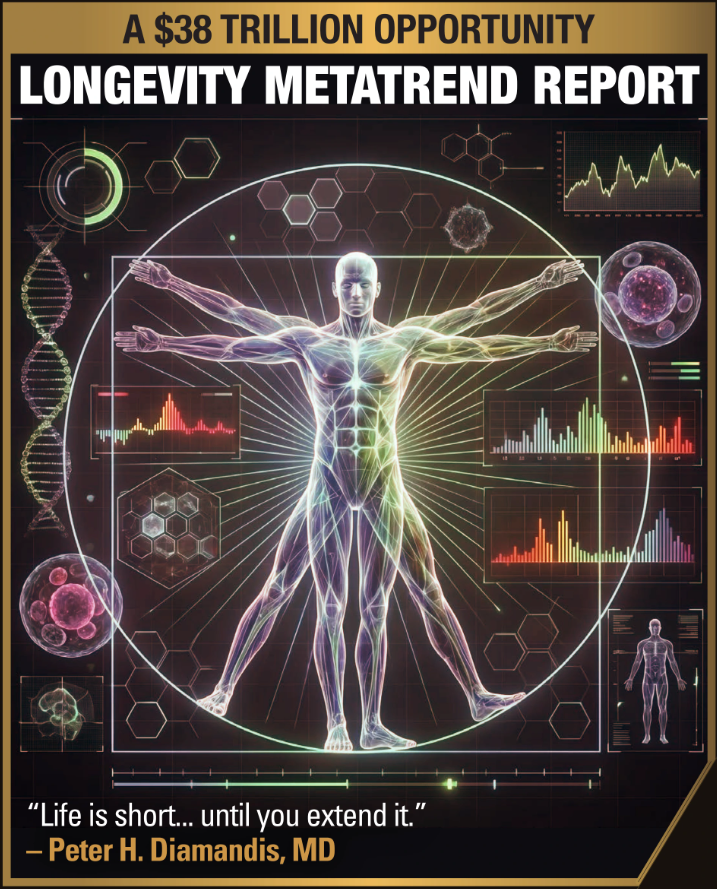
Recently, I attended the 2026 Abundance 360 Summit, where Peter Diamandis spoke about his Longevity Metatrend Report.
I can tell you something has shifted. The science of extending healthy human life is no longer a Silicon Valley fantasy. It is moving through FDA clearance, clinical trials, and real human patients right now.
This matters for your retirement plan more than almost anything else you'll read this year. Here is why.
[👉 Download the Full Longevity Metatrend Report]
What the Report Says
The headline finding comes from a recent Nature Aging paper out of Harvard, Oxford, and London Business School. Researchers calculated that every additional healthy year of life is worth $38 trillion to the global economy. Ten healthy years adds $367 trillion. That is why Jeff Bezos, Sam Altman, Brian Armstrong, and other billionaires are pouring capital into the space.
A few highlights from the report that stopped me in my tracks:
🧬 First Reprogramming Trial Cleared: The FDA approved Life Biosciences' ER-100 in January 2026, the first ever human trial of partial epigenetic reprogramming.
🤖 AI Just Crossed a Threshold: OpenAI and Retro Biosciences engineered a 50-fold improvement in cellular reprogramming using a custom protein model.
🫀 Pig Organs in Human Patients: eGenesis has transplanted CRISPR-edited pig kidneys into three living humans, with one patient living dialysis-free for 271 days.
🏆 The $101M XPRIZE Healthspan: 789 teams from 74 countries are competing to reverse functional aging by 20 years in one year of treatment.
⏱️ Longevity Escape Velocity Is Near: Multiple credible scientists believe we are within 5 to 15 years of the point where each year of life expectancy adds more than a year.
This is not hype. These are FDA filings, peer-reviewed publications, and billion-dollar clinical programs already in motion.
[👉 Download the Full Longevity Metatrend Report]
Why This Changes Your Retirement Math
Here is the uncomfortable question almost no retirement plan answers honestly: what happens if you live to 95? 100? 105?
Most financial plans run the numbers to age 90, sometimes 95. That assumption was reasonable in 1995. In a world where the CEO of Anthropic says AI could deliver 100 years of biological progress in the next 5 to 10, it is dangerous.
This is what we call longevity risk. It is the risk that your money runs out before you do. And of all the risks in retirement, longevity risk is uniquely cruel, because the worst case scenario is also the best case scenario. The longer you live, the more you spend, the more your healthcare costs, the more years your savings have to stretch.
A 65 year old today already has a real chance of seeing 95. If the science in this report delivers even a fraction of what it promises, that probability goes up, not down.
The Only Financial Product That Pays You for Being Alive
There is one financial instrument designed specifically to solve longevity risk: a lifetime income annuity.
The mechanics are simple. You give an insurance company a sum of money. They give you a paycheck. That paycheck lasts as long as you are alive. If you live to 95, you keep getting paid. If you live to 105, you keep getting paid. The insurance company takes the longevity risk so you don't have to.
Stocks don't do this. Bonds don't do this. A 4% withdrawal rule certainly doesn't do this. Lifetime income from an annuity is the only contractually guaranteed solution to the problem of not knowing how long you'll live.
Why Right Now Is a Rare Window
Here is the part that gets me genuinely excited as someone who designs retirement income plans for a living.
Annuity payout rates are tied to interest rates. We are still in the highest interest rate environment we have seen in roughly two decades. That means the lifetime income you can lock in today is materially higher than anything that was available from 2010 through 2021. In many cases, dramatically higher.
Now overlay that with the longevity research in this report. The science is on the verge of disrupting how long people live. Insurance carriers price their annuities using mortality tables that lag the science. There is a window where you can lock in elevated payout rates based on today's mortality assumptions and then benefit from every additional year the science delivers.
That is not a small thing. That is the kind of intersection that almost never shows up in financial planning. High rates plus accelerating longevity equals one of the most attractive moments in a generation to consider building lifetime income into your retirement plan.
What To Do With This
First, read the report. Even if you don't act on the financial side, understanding where human longevity is headed will change how you think about the next 30 years of your life.
Then, if you are within 10 years of retirement (or already there), let's talk through what longevity risk looks like in your specific plan and whether locking in lifetime income makes sense for you before rates come back down.
[👉 Schedule Your Retirement Risk Review]
At Gibson Capital, LLC, we help people plan for the retirement they actually want, not the one they are afraid of. The longevity revolution is one of the strongest arguments I have seen in 20 years for building guaranteed lifetime income into the foundation of a retirement plan.
Live long. Plan accordingly.
Steven Gibson Owner, Gibson Capital, LLC
This article is for educational purposes only and does not constitute investment, tax, or legal advice. Annuity guarantees are subject to the claims-paying ability and financial strength of the issuing insurance carrier. Lifetime income annuities are long-term contracts with specific terms, fees, and surrender charges that should be reviewed carefully. Please consult a licensed professional regarding your specific situation.